
How Long to Use Red Light Therapy on Face? 5 Costly Mistakes That Waste Your Money
SaintQueen · Light Therapy Guide
You bought the device. You lie under it every night. But are you actually getting a full dose — or just a warm glow and wasted electricity?
Here is the uncomfortable truth: with photobiomodulation, time is not the dose. Session length only works when it matches your device's power, your distance from the LEDs, and your skin's recovery rhythm. Get any of these wrong and you can use a $460 machine every day for a year and see almost nothing. These are the 5 mistakes we see most often — and exactly how to fix each one.
The 30-Second Answer
These are the ranges used across published photobiomodulation protocols for skin. The 5 mistakes below explain why — and what happens when you ignore them.
Mistake 01
"Longer sessions = faster results."
The mistakeCranking the timer to 45–60 minutes because "more light must mean more collagen."
Red light therapy follows a well-documented biphasic dose response: too little light does nothing, the right dose stimulates cellular repair, and too much light actively suppresses it. In cell studies, doses around 3.7–5 J/cm² stimulated growth — while 7.4–11 J/cm² produced weaker or even negative responses. Past the optimal window, your extra 30 minutes aren't neutral. They're counter-productive.
The fix
For facial skin work, stay in the 10–15 minute zone per session. On the SQ22, set the timer manually instead of leaving the 30-minute default — the default is a full-body comfort setting, not a facial protocol.
Mistake 02
"15 minutes is 15 minutes — on any device."
The mistakeCopying a session time from a YouTube video without asking what device it was filmed on.
The real unit of light therapy is not minutes — it's dose, measured in joules per cm²:
Dose (J/cm²) = Irradiance (mW/cm²) × Time (seconds)
A high-density device delivers in 10 minutes what a weak handheld delivers in 30. This is why generic advice fails both ways: copy a low-power routine onto a strong panel and you overshoot; copy a high-power routine onto a $50 wand and you're basically sitting in mood lighting.
The fix
Match time to hardware. The SQ22 packs 468 LED beads across wrap-around panels — a high-density layout. For a device in this class, 10–15 minutes on the face is a full therapeutic session. If you're on a small single-panel handheld, you'll genuinely need longer. Same minutes ≠ same dose.
Mistake 03
"Distance doesn't matter as long as the light reaches me."
The mistakeSitting an arm's length — or a room's length — away from the panel and assuming the glow on your skin is "treatment."
Light intensity obeys the inverse-square law: double the distance and you get roughly one-quarter of the intensity. Move from 6 inches to 12 inches and your dose drops by ~75%. People who "do red light therapy" from 3 feet away are often receiving less energy in 20 minutes than they'd get in 3 minutes at the correct distance — then concluding the technology doesn't work.
The fix
Keep the LEDs close to the skin — roughly 6–12 inches (15–30 cm). This is exactly why the SQ22 uses a space-capsule arch that wraps over your face and body at short range instead of a flat panel you place across the room: the geometry keeps every one of the 468 beads inside the effective distance zone for the entire session.
Mistake 04
"Two weeks in, no change — this thing is a scam."
The mistakeQuitting at week 2 — or doing 2 sessions this week, none for 10 days, then 1 more — and declaring failure.
Photobiomodulation results are cumulative. Collagen remodeling runs on a biological calendar, not a cosmetic one: most skin protocols in the research literature run 8–12 weeks at 3–5 sessions per week before visible change is assessed. Irregular use never builds the cumulative dose-response curve those studies are based on.
The fix
Commit to a real course: 10–15 min × 3–5× per week × 8–12 weeks, then reassess with before/after photos taken in the same lighting. After that, drop to 2–3 maintenance sessions per week. The SQ22's 5 kg foldable frame helps here more than any spec sheet does — a device that lives unfolded by your bed gets used; one buried in a closet doesn't.
Mistake 05
"Three sessions a day will triple my results."
The mistakeMorning, noon and night sessions to "speed things up" before an event.
Once your cells absorb a therapeutic dose, they hit a saturation point — and they need roughly 24–48 hours to process that energy into actual repair activity. Additional light in the same day doesn't stack; it just idles (or worse, pushes you past the biphasic window from Mistake 01). There is no protocol in the literature where 3× daily sessions out-perform 1× daily.
The fix
One session per day, per area, is the ceiling. If you want to do more, do it consistently — frequency across weeks beats intensity within a day, every time.
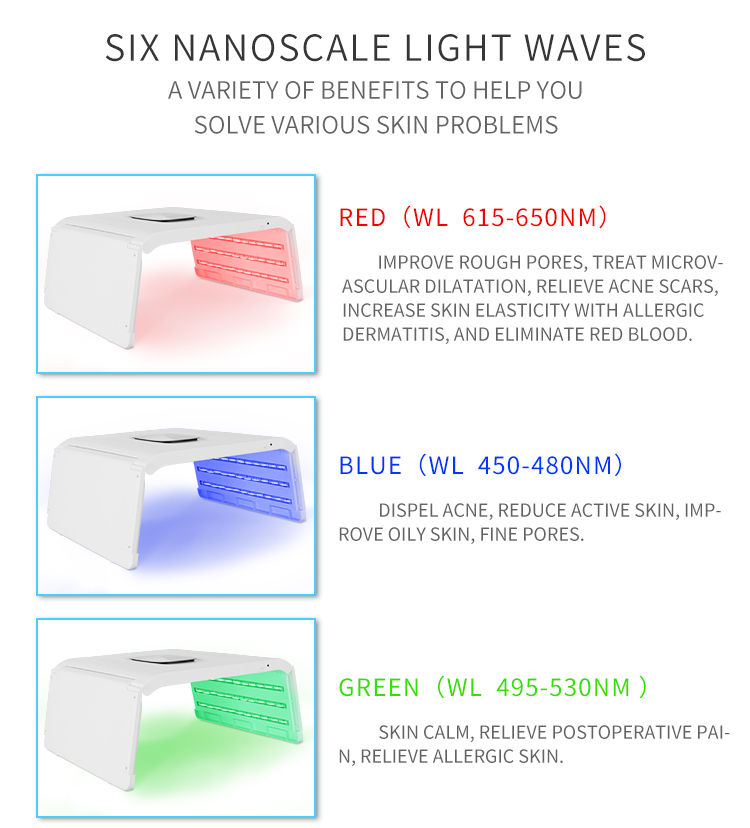
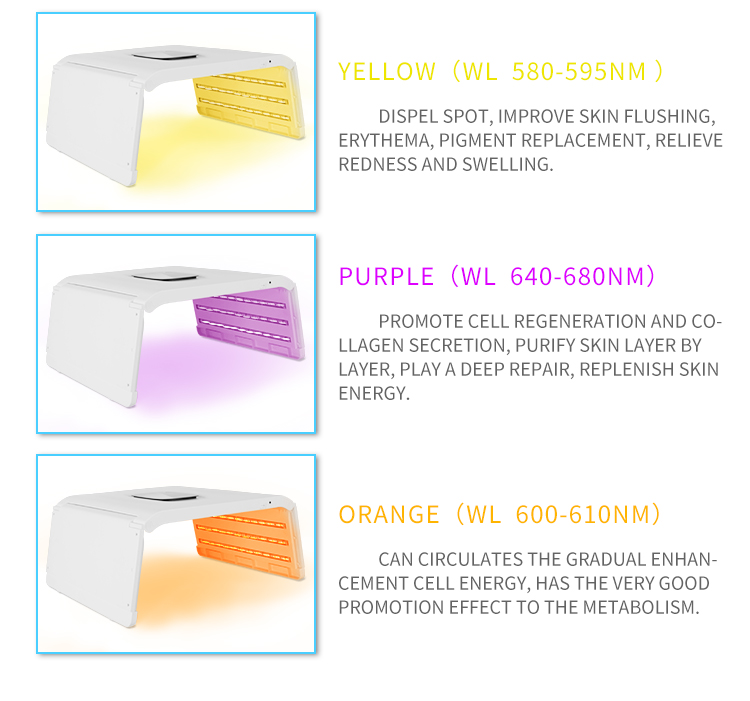
Facial Session Guide by Wavelength (SQ22)
| Light | Wavelength | Facial goal | Time / session | Frequency |
|---|---|---|---|---|
| Red | 615–650 nm | Firmness, elasticity, fine lines | 10–15 min | 3–5× / week |
| NIR (IR/Red key) | ~850 nm | Deeper tissue support, recovery | 10–15 min | 3–5× / week |
| Blue | 450–480 nm | Oily, breakout-prone skin | 8–12 min | 3–4× / week |
| Green | 495–530 nm | Calming, redness-prone skin | 10 min | 3–4× / week |
| Yellow | 580–595 nm | Flushing, visible redness | 10 min | 3–4× / week |
| Purple | 640–680 nm | Regeneration support | 10 min | 2–3× / week |
| Orange | 600–610 nm | Dullness, vitality | 10 min | 2–3× / week |
| Cycle mode | All + NIR | General full-face maintenance | 15 min | 2–3× / week |
New to light therapy? Start at the low end (8–10 min), 3× per week, and build up over 2 weeks. Sensitive or reactive skin: begin with Green or Yellow before introducing Red/NIR.
A Correct SQ22 Facial Session, Step by Step
- Cleanse first. Makeup, sunscreen and skincare absorb light before it reaches your skin — light therapy goes on a bare, dry face, skincare goes on after.
- Put on the goggles. They're in the box for a reason. Red and NIR at therapeutic intensity deserve respect for your retinas — and you can't feel retinal damage happening.
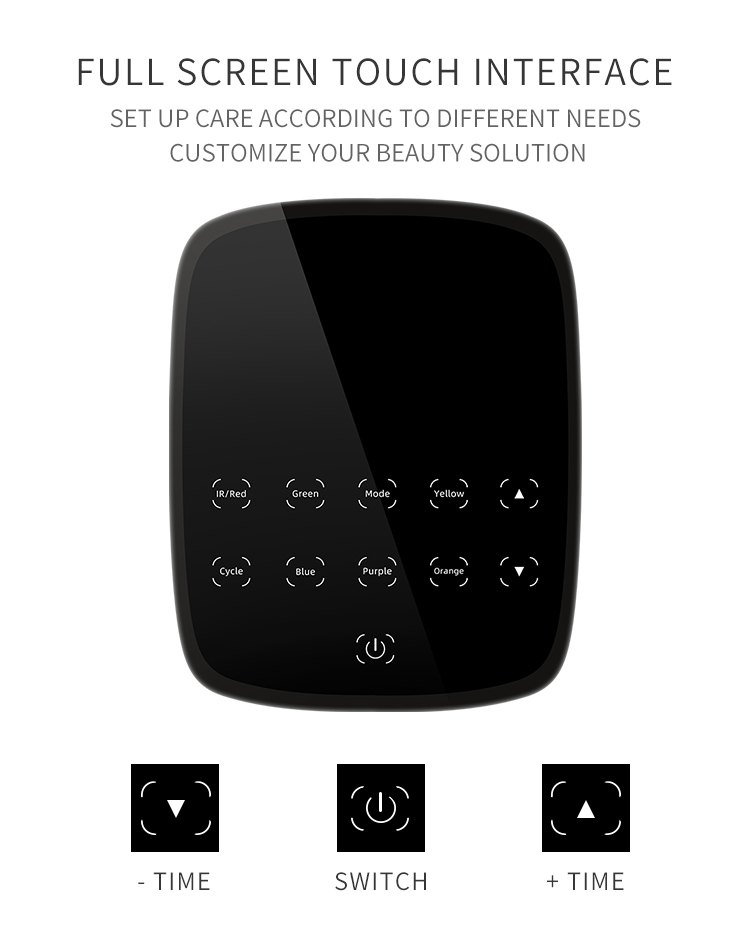
- Pick your wavelength. Press the dedicated color key (or IR/Red for near-infrared). Not sure? Cycle mode rotates through all colors for general maintenance.
- Set the time: 10–15 minutes. Use the − TIME / + TIME keys. Don't just accept the 30-minute default for facial work.
- Set brightness around 50–70% for your first two weeks, then adjust toward comfort. Higher brightness = higher dose per minute.
- Lie down, position the arch over your face at close range, relax. Red and NIR won't disrupt melatonin, so evening sessions are fine (if you're Blue-light sensitive before bed, schedule blue sessions earlier).
- After: apply your skincare, drink water, log the session. Consistency tracking is what gets you to week 8.
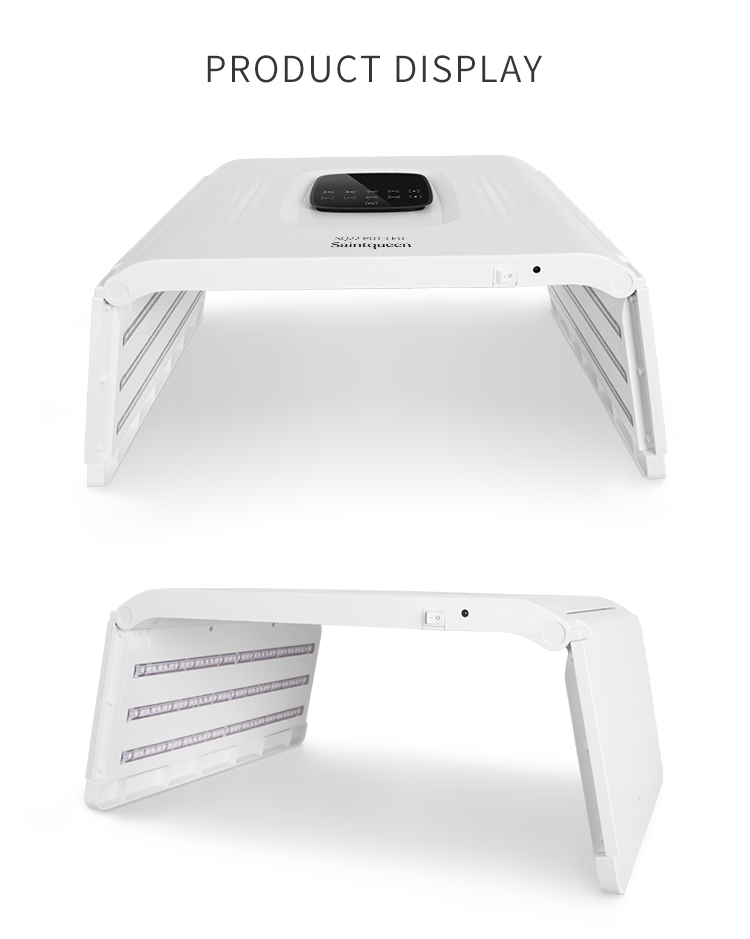
Featured Device
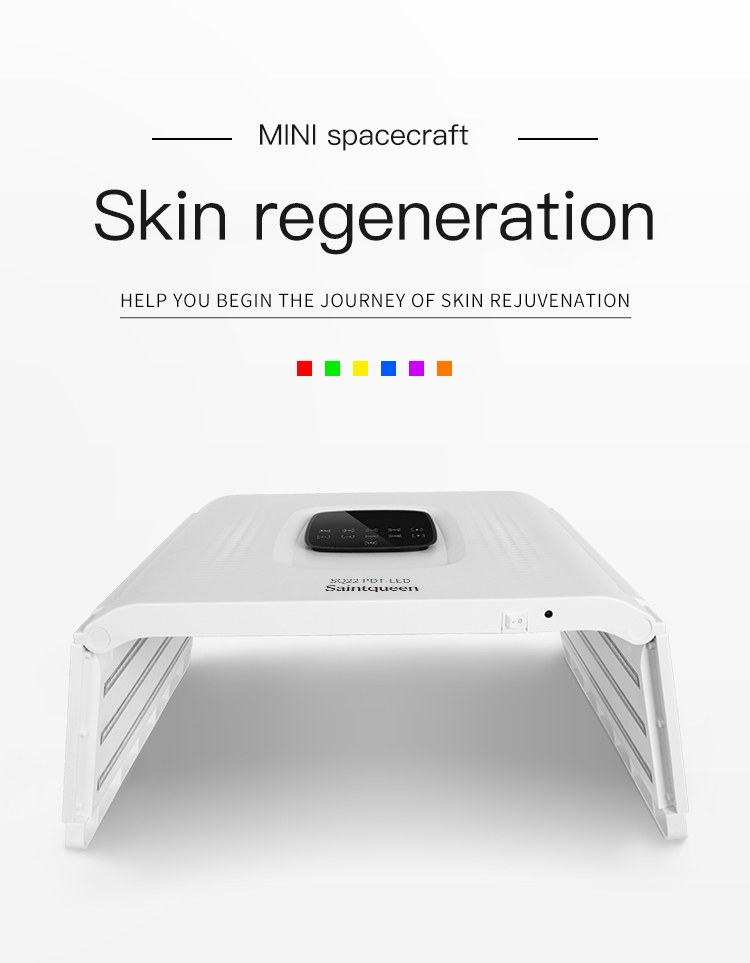
SQ22 Foldable Mini Space Capsule
Full-Body 7-Color 468-Bead LED + NIR Light Therapy Machine
- 468 LED beads — wrap-around panels keep every diode inside the effective 6–12 inch zone
- 7 colors + NIR near-infrared + automatic Cycle mode
- Time 5–60 min · Brightness 9–99% · Temperature 38–60°C — full dose control on one touch panel
- Folds flat at 5 kg — the device you'll actually use 5× a week
- Protective goggles included · US / EU / UK / AU plug · 1-year warranty
U$459.99 · Free express shipping over U$50
View the SQ22 →FAQ
Is 10 minutes really enough for the face?
Yes — with a high-density device at close range. Dose is irradiance × time: a 468-bead wrap-around panel at 6–12 inches reaches the effective 4–10 J/cm² skin window inside 10–15 minutes. With a low-power handheld you'd need longer; with this class of hardware, 30+ minutes pushes you toward the inhibitory side of the biphasic curve.
Can I use red light therapy on my face every day?
Once a day per area is the sensible maximum — cells saturate and need 24–48 hours to convert light energy into repair. Most skin protocols run 3–5 sessions per week. Daily use isn't dangerous at sensible doses, but it adds nothing and makes it harder to stay consistent long-term.
Morning or evening — does timing matter?
No physiological difference for red and NIR — they don't suppress melatonin, so evening use won't harm sleep. Blue light is more alerting; if you're sensitive, run blue sessions earlier in the day. The best time is the slot you'll actually keep 4× a week for 8–12 weeks.
Should I apply skincare before or after my session?
After. Serums, creams, oils and sunscreen all absorb or scatter light and cut your delivered dose. Cleanse, dry, do your session on bare skin, then apply your routine immediately after — some users find post-session skin absorbs product better.
Do I really need the goggles?
Yes. The retina has no pain receptors, so direct exposure to therapeutic-intensity red and NIR can accumulate damage without any warning sensation. The SQ22 ships with protective goggles — wear them for every facial session.
Why am I not seeing results after 3 weeks?
Almost always one of the 5 mistakes above: sessions too long or too short for your device, too much distance, irregular schedule, or expecting collagen-level change inside a 2–3 week window. Take a same-lighting photo at week 0, 4, 8 and 12 — change this gradual is invisible day-to-day but obvious across months.
